
If you manage a condo, apartment building, hospital, hotel or office tower, your domestic hot water storage tanks are easy to forget until one leaks. When that happens, most people assume the answer is a new tank. Often it isn’t.
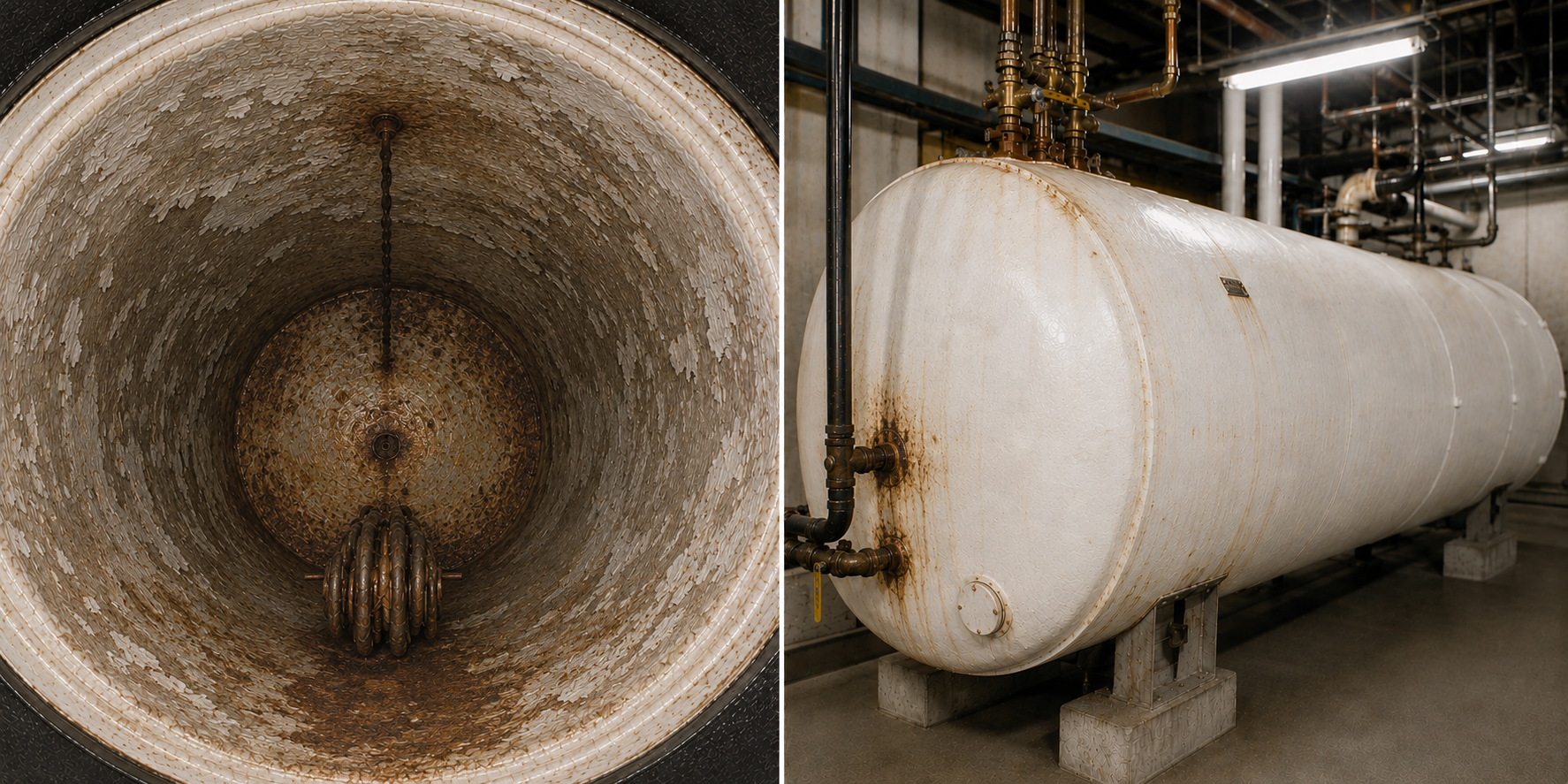
Inside and outside a commercial hot water storage tank at around ten years. The lining is visibly deteriorating, which is usually the last practical window for relining.
The short answer
If the steel shell is still structurally sound, relining is usually the better option. It restores the protective barrier inside the tank, extends its service life and avoids the cost and disruption of pulling a large tank out of a mechanical room. If the shell itself is badly pitted or has leaked through in more than one place, replacement is usually the right call. The only way to know which side of that line you’re on is to look inside the tank.
Why commercial hot water tanks fail
Most large domestic hot water tanks are protected by an interior lining and sacrificial anodes. Over time the anodes deplete, sediment builds up, fittings corrode, and the lining starts to crack or separate from the steel. Once water reaches the steel, corrosion speeds up. Because all of this happens inside the tank, a tank can look fine from the outside and still be deteriorating.
When relining makes sense
The tank has a manway, so a technician can get inside to inspect it and prepare the surface.
The lining is deteriorating, but the steel shell is still sound.
Corrosion is limited to fittings, couplings or small areas that can be weld repaired.
Replacing the tank would mean major disruption, like rigging a large vessel out of a rooftop or basement mechanical room.
When replacement makes sense
Corrosion has spread from the fittings to the tank body and the steel is flaking or pitting.
The tank has leaked through the shell in more than one place.
The tank is a smaller glass-lined unit without a manway. These can be maintained, but not relined.
What we typically see as a tank ages
Without regular maintenance, this is the pattern we see in the field. A new tank starts with a fresh lining, a new anode and clean fittings. By around five years the anode is often fully depleted and corrosion begins forming around fittings and couplings. By around ten years the lining is visibly deteriorating, which is usually the last practical window for relining before costs rise. By around fifteen years the lining has failed, corrosion has reached the tank body, and emergency replacement becomes the likely outcome.
What does relining cost compared to replacement?
Relining usually costs a fraction of replacement, often less than 10% of the cost of a new tank, even when some weld repair is needed. It also avoids the downtime and rigging involved in getting a large tank out of a mechanical room.
Who does this work
Hydrastone Inc. inspects, maintains, repairs, relines and replaces domestic hot water storage tanks in commercial, institutional and multi-residential buildings across Canada, with teams serving Ontario, Calgary and Vancouver. We also manufacture Alkrete, the CSA and NSF/ANSI 61 certified cement lining that Canadian tank manufacturers apply at the factory. When we reline a tank, we’re restoring the same lining system it left the factory with.
If you aren’t sure where your tanks stand, we offer a free tank assessment. Call 416-902-8265 in Toronto, 778-996-8265 in Vancouver or 403-466-8645 in Calgary, or email info@hydrastone.com.
